


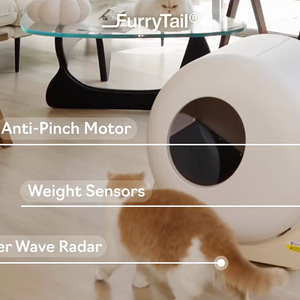

Start with your cat's body length, then compare the space inside the box and the room needed to use and clean it.
Measure from the Nose to the Base of the Tail
Measure your cat when they are standing or resting in a naturally extended position. Take the body length from the tip of the nose to the base of the tail, leaving the tail itself out of the measurement. A nearby ruler or tape can help you estimate the distance without holding your cat in place.
Write down the measurement and unit. If your cat curls up or moves away, try again later rather than stretching or restraining them. You are establishing a starting point for comparing boxes, then checking how comfortably your cat can actually enter, turn and dig.
Use About One and a Half Body Lengths as a Starting Reference
The AAFP Cat Friendly Practice guide describes a litter box about one and a half times the cat's nose-to-tail-base length. Use this as an ordinary-box selection reference, comparing the space available inside rather than a large external shell.
For example, an illustrative body length of 40 cm gives 40 × 1.5 = 60 cm, or about 23.6 inches, as a starting length to look for. Use the same calculation with your cat's measured body length. Also check width, turning room and the opening. Curved automatic interiors need model-specific assessment; this calculation does not establish that a particular powered unit fits.

Check the Opening and the Space Above the Litter
| Detail | What to compare |
|---|---|
| Usable length and width | The unobstructed area where your cat stands and turns |
| Entry | The opening width and the step your cat must negotiate |
| Headroom | Space above the normal litter level, including any cover or curved wall |
| Interior shape | Narrow points or sloping sides that reduce movement despite a large exterior |
Choose an entry your cat can manage easily. A long box with an awkward opening can still be difficult to use. Watch ordinary entry and turning rather than placing your cat inside for a forced test. For mobility concerns, ask your veterinarian which access features would suit your cat.
Measure the Space Needed Around the Box
Mark the proposed footprint on the floor, then account for the parts that move during care. A lid needs lifting room; a drawer needs space to come out; a removable tray needs somewhere to be carried. For powered equipment, also follow the placement and power-cord instructions for that exact model.
Try the maintenance movement with the surrounding furniture in place before choosing the location. A box that just fits between two cabinets may leave no practical route for removal or cleaning. Keep your cat's approach clear as well as your own access. Use the litter box quantity and placement guide when planning several stations.
Compare the Usable Measurements Side by Side
Worked example: compare two hypothetical manual trays for the 40 cm cat measured above.
| Measurement | Example A | Example B |
|---|---|---|
| Clear inside length | 60 cm | 45 cm |
| Clear inside width | 40 cm | 35 cm |
| Entry and movement | Still need to be checked | Still need to be checked |
| Initial decision | Meets the 60 cm starting length reference | Shorter than the starting length reference |
For Example A, check the entrance, headroom and room to turn and dig next. For Example B, look for more usable interior length. Record outside dimensions, inside dimensions and entrance measurements separately when comparing real products.
Confirm the Exact Model Before Making the Switch
For the Automatic Litter Box Pro, review current model instructions for eligibility, entry, usable interior and placement. If a needed measurement is not shown, ask product support rather than estimating it from the outside or from capacity. A capacity figure and the machine's own weight do not describe your cat's turning space.
During a gradual introduction, watch whether your cat enters willingly, turns without pressing against the sides and uses the litter comfortably. Keep a familiar box available. Set the litter level using the model instructions and our litter amount guide, which separates ordinary trays from automatic equipment.


